When Apple released its Retina Display, it made the screens not only better, but altered the way we perceive screens. The pictures were realistic, the text was printed, and the color appeared to jump out of the screen. However, one thing remains to be asked: is Retina Display 4K?
On the face of it, these two may appear to mean the same thing, both being stunningly clear and high-resolution. However, in practice, they are talking about very different things. We are going to have it all broken down and find out what really makes Retina Display and 4K different, and whether you get your money worth with Retina.
Table of Contents
What Is a Retina Display?
The Retina Display was unveiled by Apple in 2010 when the iPhone 4 was launched, and it was based on a single objective making pixels not visible to the human eye at regular viewing distances. It was not only the idea of a resolution but of pixel density, in pixels per inch (PPI).
How Retina Works
Rather than establishing a fixed resolution, Apple varies the pixel density of each Retina Display depending on the size of the screen. This makes sure that it all looks pointy and smooth regardless of the device.
An iPhone, an example, has a smaller display with a higher number of pixels in it, whereas a MacBook or iMac has a bigger display with a marginally lower density but still retains the same sharp look.
The aim is to ensure that the text, icons, and images look like real-life, almost like you were reading a printed page.
What Does 4K Mean?
The 4K resolution standard has achieved 3840 x 2160 pixels, four times that of Full HD. The 4K gets its name out of the number of pixels on the horizontal side of the screen, which is approximately four thousand.
The Purpose of 4K Resolution
The 4K standard considers only the number of pixels. The higher the number of pixels, the more specifics, the sharper the texture, the clearer the image, primarily on larger screens. To content creators, gamers, and filmmakers, 4K is best in viewing and editing ultra-high-definition images.
Nevertheless, 4K does not scale according to the size of the screen. It is not particularly the perception but the raw pixel data so whether it is a 27-inch monitor or it is a 55-inch TV, it is 4K.
Is Retina Display 4K?
Herein the confusion arises. The simple answer is NO, Retina Display is not necessarily 4K.
Retina is a marketing and design concept that concentrates on the perception of sharpness in the eye of a human being. 4K, conversely, is a fixed technical benchmark that is based on the number of pixels.
How Retina and 4K Compare
Other Retina Displays match or even surpass the 4K resolution, whereas others are slightly less than it yet appear equally sharp due to pixel density.
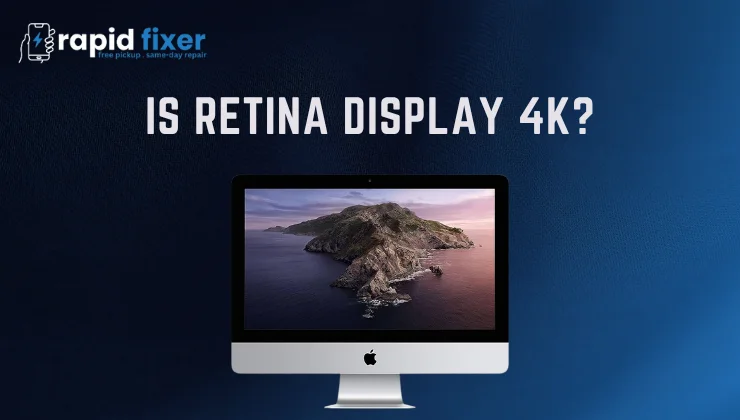
As an example, the iMac 24-inch has a Retina 4.5K display (4480 × 2520 pixels), and the iMac 27-inch has a Retina 5K display (5120 × 2880 pixels). Meanwhile, MacBooks, such as the 14-inch and 16-inch models, have resolutions of about 3K yet they still seem just as sharp because of their smaller screens.
Therefore, it can be said that Retina can be 4K but does not have to be. The power of the technology is in the optimization of our image perception, not in reaching a certain number of pixels.
Is MacBook Retina Display 4K?
When you question yourself whether your MacBook has 4K Retina Display, it varies depending on the model.
MacBook Display Comparison
The MacBook Air has a Retina resolution of 2560 × 1600, and the MacBook Pro 14 has 3024 × 1964, and the 16-inch MacBook Pro has 3456 × 2234. They are not really 4K, but the pixel density and color calibration give them almost the same sharpness.
Your eyes will not see the difference between these displays and a real 4K screen at a normal viewing distance. That is the genius of Retina technology, it provides 4K-quality resolution without the power requirements of a full 4K panel.
Retina Display vs 4K
Both the Retina and the 4K are to provide an exceptional clarity but in different ways.
The Retina Approach
Apple created Retina based on human visual perception. Rather than paying attention to the figures, Retina makes the screen appear flawless at regular distances. Each device has a resolution specific to its size and intended use.
The 4K Approach
The 4K is based on a standard resolution. The same is the case with monitors, TVs, and cameras. Its consistency is what makes it great in the professional video production and big screens where every pixel counts.
Concisely, Retina is dynamic and perception-based, whereas 4K is standard and specification-based.
Is Retina Display 4K Worth It?
The thing is not whether Retina is 4K or not, it is whether it is worth it or not, and the answer is a resounding yes.
Why Retina Displays Stand Out
Retina Displays are tuned to color, tightness, and contrast. They capture a realistic look that is not pixelated, even when zoomed in; moreover, the hardware and software optimization means an easy use and improved battery life.
When you are doing creative tasks such as design, photo editing, play videotapes, you will find that everything looks natural and consistent. Text is even sharper to normal users, and movies seem more immersive.
Retina displays are performance-efficient unlike other 4K displays. They provide high-quality images without wasting power or congesting the graphics card.
Is Retina Display the Same as 4K?
No, Retina Display and 4K are not identical.
4K is simply a matter of quantity of pixels 3840 x 2160 to be precise. Retina is how those pixels are perceived. Depending on the size and design of a device, a Retina screen may be above or below 4K.
As an example, the MacBook Air is not 4K, but its Retina display is sharper than even some 4K laptops due to the better pixel density and color adjustment used by Apple.
Retina pays attention to the visual experience, rather than figures – and that is what makes it special.
Choosing Between Retina and 4K
The decision between a Retina Display and a 4K screen depends on what you consider the most important.
When to Choose Retina
A Retina Display will be a good choice when you value natural colors, smooth images, and power-saving. It is perfect in daily life, in creative tasks, and in work when a person needs the best pictures and does not want to waste additional battery life.
When to Choose 4K
However, in case you are working on high-resolution video, using large monitors, or just require pixel-perfect-accuracy in a post-production workflow, then a real 4K display may be better suited.
To the majority of users, however, Apple Retina technology offers the best compromise, offering the clarity of 4K, all-day performance, and comfortable-tune visuals.
Final Thoughts
So, is Retina Display 4K? Not precisely, but it is equally spectacular, perhaps more. Retina Display is concerned with the development of a pixel-perfect display to the human eye and 4K is concerned with providing a fixed resolution.
Practically, Retina is just as sharp as 4K, and in most situations, has superior color calibration, and efficiency. Whether you are watching a film, editing pictures, or reading, the retina technology on Apple offers breath-taking clarity and balance.
They both seek to provide awe-inspiring visuals, but Retina manages to do so in a more human-friendly manner – establishing it as one of the most sophisticated display technologies nowadays.
FAQs About Is Retina Display 4K?
Is Retina Display better than 4K?
Not really better, but Retina Displays can frequently appear as sharp as 4K, as they are optimized to look good on your eyes. It is not possible to see the individual pixels, and that makes the experience appear as detailed.
Is MacBook Retina Display 4K?
The resolutions of most MacBooks are a little under 4K, yet due to the Retina technology, the choice is almost indistinguishable. The images are equally sharp and bright.
Is Retina Display 4K worth it?
Absolutely. Retina Displays offer the ideal combination of sharpness, color fidelity, and power saving. Retina has plenty of visual quality unless you are editing 4K video every day.
Is Retina Display the same as 4K?
No, Retina and 4K are different. Retina is Apple optimized display technology and 4K is a fixed resolution standard.
Does Retina Display support 4K content?
Yes. The Retina Displays are capable of playing 4K video and images effortlessly. Although the screen may not be 4K, Apple software makes the images look crisp and high-quality.